Muscles (lateral view)
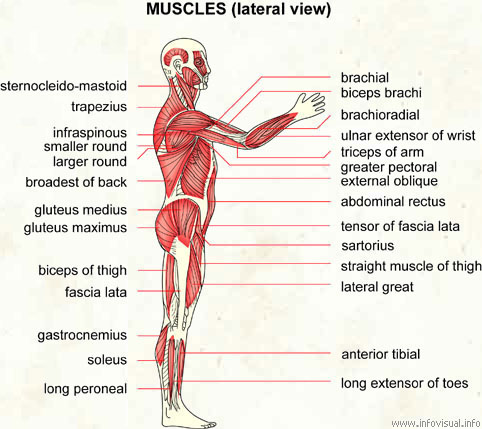
Brachial: muscle of the outer arm.
Biceps brachi: an arm muscle with two points of attachment.
Brachioradial: muscle used to rotate the hand.
Ulnar extensor of wrist: muscle connected to the elbow.
Triceps of arm: an arm muscle with three points of attachment.
Greater pectoral: bulky chest muscle.
External oblique: muscle whose fibres are oblique in relation to the body when it is standing.
Abdominal rectus: abdominal muscle with vertical fibres.
Tensor of fascia lata: muscular membrane that stretches and tightens.
Sartorius: muscle that pivots the lower leg on the thigh and the thigh on the pelvis.
Straight muscle of thigh: vertical muscle above the knee.
Lateral great: large muscle of the outer thigh.
Anterior tibial: muscle of the leg below the knee.
Long extensor of toes: muscles that extends the toes.
Long peroneal: muscle below the peroneals and above the metatarsals.
Soleus: extensor muscle of the foot.
Gastrocnemius: the two muscles of the calf.
Fascia lata: membrane enveloping and supporting a muscle or group of muscles.
Biceps of thigh: leg muscles with two points of attachment.
Gluteus maximus: large buttock muscle.
Gluteus medius: buttock muscle.
Broadest of back: large back muscle.
Larger round: large muscle involved in the movements of the shoulder.
Smaller round: small shoulder muscle.
Infraspinous: muscle below the dorsal spine.
Trapezius: back muscle between the scapula and the spinal column.
Sternocleido mastoid: neck muscle connecting the sternum to the clavicle and relative to the mastoid process.
Photo :

Domestic goats are one of the oldest domesticated species. For thousands of years, goats have been used for their milk, meat, hair, and skins all over the world. Most goats naturally have two horns, of various shapes and sizes depending on the breed. While horns are a predominantly male feature, some breeds of goats have horned females. Polled (hornless goats) are not uncommon and there have been incidents of polycerate goats (having as many as eight horns), although this is a genetic rarity thought to be inherited. Their horns are made of living bone surrounded by keratin and other proteins and are used for defense, dominance, and territoriality.
Goats are ruminants. They have a four-chambered stomach consisting of the rumen, the reticulum, the omasum, and the abomasum. Goats have horizontal slit-shaped pupils, an adaptation which increases peripheral depth perception. Because goats' irises are usually pale, the pupils are much more visible than in animals with horizontal pupils but very dark irises, such as sheep, cattle and most horses.
Both male and female goats have beards, and many types of goats may have wattles, one dangling from each side of the neck. Some breeds of sheep and goats appear superficially similar, but goat tails are short and point up, whereas sheep tails hang down and are usually longer, though some are short, and some long ones are docked.