Male genital organs
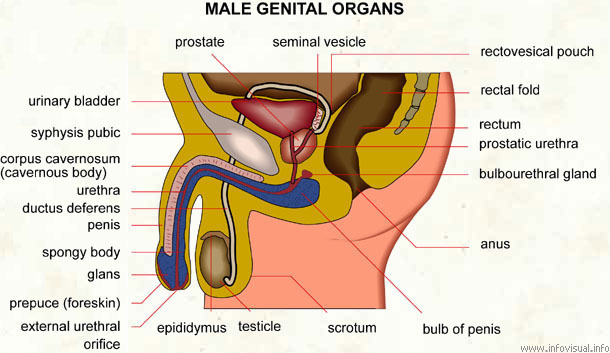
Prostate: gland secreting one of the components of sperm.
Seminal vesicle: small sac related to the semen.
Rectovesical pouch: bottom of the recto-vesical cavity.
Rectal fold: fold related to the rectum.
Rectum: final part of the large intestine, between the sigmoid and the anus.
Prostate urethra: conduit related to the prostate.
Bulbourethral gland: gland related to the bulb and the urethra.
Anus: end of the large intestine, through which the human body expels solid waste.
Bulb of penis: enlargement of the penis.
Sctotum: small sac under the penis containing the testicles.
Testicle: spermatozoa-producing gland.
Epididymus: canal through which the sperm passes.
External urethral orifice: end of the urethra.
Prepuce (foreskin): cutaneous fold covering the glans penis.
Glans: enlarged end of the penis.
Spongy body: spongy tissue.
Penis: external sexual organ of a man.
Ductus deferens: tube carrying sperm out of the penis.
Urethra: small tube through which the human body expels liquid waste.
Corpus cavernosum (cavernous body): more or less empty space.
Symphysis pubis: semi-mobile pubic joint.
Urinary bladder: pocket in which urine collects.
Photo :
EN : Tongue
lower surface
FR : Langue
face inférieure
ES : Lengua
cara inferior
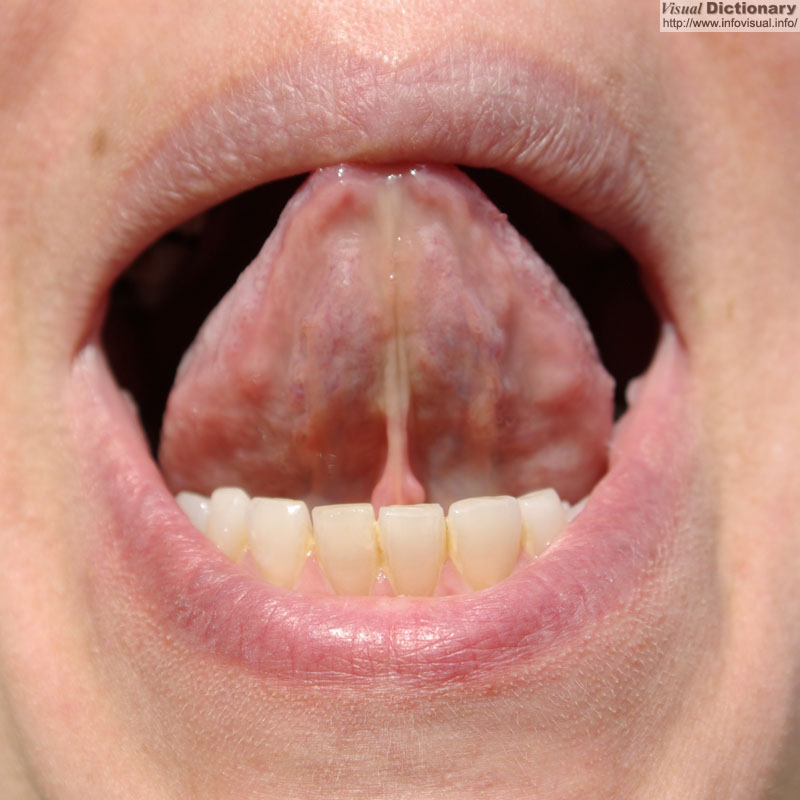
Since the tongue contains no bony supports for the muscles, the tongue is an example of a muscular hydrostat, similar in concept to an octopus arm. Instead of bony attachments, the extrinsic muscles of the tongue anchor the tongue firmly to surrounding bones and prevent the mythical possibility of 'swallowing' the tongue.
Animation : Male Reproductive System
Thanks to YouTube for allowing us to watch this video.