Symphony orchestra
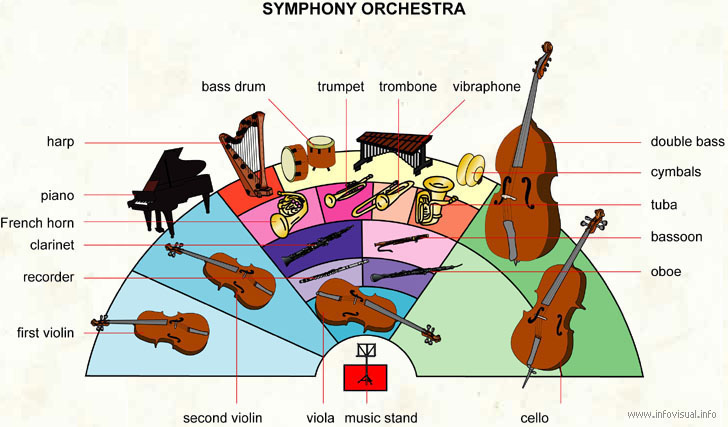
Bass drum: the biggest drum of the set, it produces a deep low sound.
Trumpet: brass instrument having 3 valves and producing up to 12 notes.
Trombone: brass instrument generally having a slide to produce a variety of sounds.
Double bass: the largest instrument of the violins family, producing the most bass notes.
Cymbals: metal discs that are hit with a mallet or stick, or one on the other to produce a sound.
Tuba: instrument made of a curves tube ending with a bell, it produces the most bass sounds of the brass family instruments.
Bassoon: conical double reed instrument of the oboe family.
Oboe: woodwind double reed instrument with a conical bore.
Cello: violin shaped instrument, larger than a violin, that is placed upright between the knees to play.
Music stand: lectern that supports the score.
Viola: larger version of the violin producing notes of one octave lower.
Second violin: support the melody of the first violin. Usually plays the harmony.
First violin: plays the melody.
Recorder: instrument of which the sound is produced with a whistle mouthpiece.
Clarinet: reed instrument with a large flared bell.Woodwind double reed instrument with a conical bore.
French horn: conical brass instrument made with a tube coiled in a circle and ending in a flared bell.
Piano: stringed instrument played with a keyboard that makes hammers strike tuned strings to produce the sounds.
Harp: asymmetrical triangular instrument having different length strings that are plucked to play.
Photo :
EN : Bells
(ceramic)
FR : Cloche
ES : Campana

A bell is a simple sound-making device. The bell is a percussion instrument and an idiophone. Its form is usually an open-ended hollow drum which resonates upon being struck. The striking implement can be a tongue suspended within the bell, known as a clapper, a small, free sphere enclosed within the body of the bell, or a separate mallet. Bells are usually made of cast metal, but small bells can also be made from ceramic or glass. Bells can be of all sizes: from tiny dress accessories to church bells weighing many tons.